

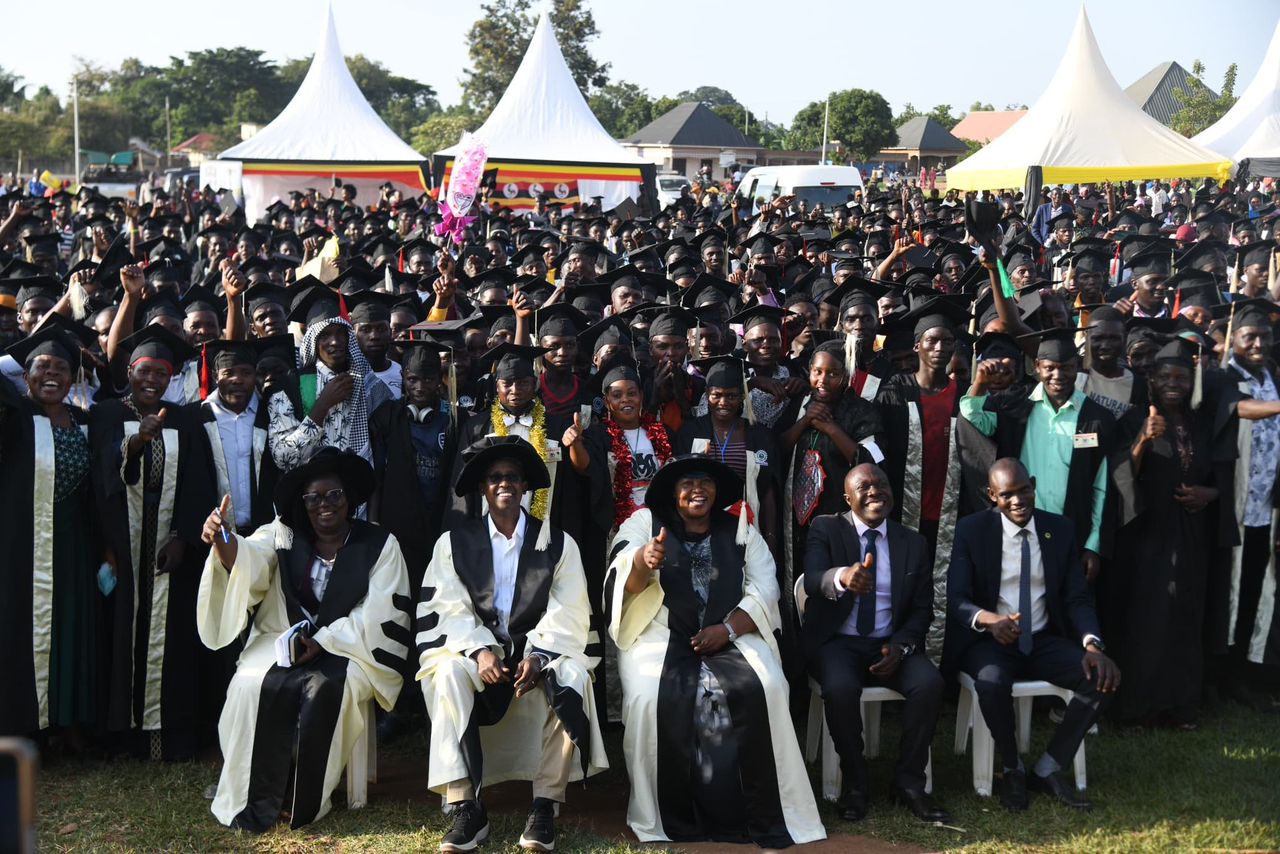
The Minister for the Presidency, Milly Babirye Babalanda, has called for the expansion of vocational skills training across Uganda, emphasising its role in tackling youth unemployment, promoting self-reliance, and accelerating industrialisation as the country advances towards upper-middle-income status.
Babalanda made the remarks on Friday while presiding over a graduation ceremony at Bugweri District Headquarters, where more than 2,000 students graduated with Directorate of Industrial Training certificates in various vocational skills under the Uganda Vocational and Technical Assessment Board, in collaboration with the Ministry of Education and Sports and the Presidential Advisory Committee on Exports and Industrial Development.
She thanked the people of Bugweri District for supporting President Museveni in the last elections, describing his current term as one focused on fighting corruption and improving service delivery.
“The concept of vocational skills in Uganda is to shift education from purely academic theory to practical, employment-focused training that addresses the country’s economic and social realities,” Babalanda said.
The minister noted that vocational training is central to addressing youth unemployment and underemployment, observing that more than 70 per cent of Uganda’s population is below the age of 30 while the formal job market cannot absorb all university graduates.
She said vocational skills equip young people with practical abilities in trades such as carpentry, mechanics, agriculture, bakery, building and construction, ICT, tailoring, and catering, enabling them to either create their own jobs or secure employment in the private sector.
Babalanda added that vocational skilling supports Uganda’s broader development agenda, including Vision 2040 and the Parish Development Model, both of which require a skilled workforce to transition the country from a subsistence to a modern industrial economy.
“As President Museveni focuses on driving Uganda’s economy into upper-middle-income status, skilling will help to push our economic growth and industrialisation,” she said.
She further noted that vocational training promotes self-reliance and poverty reduction by enabling Ugandans, especially those in rural communities, to add value to local products, establish small businesses, and generate household income.
According to Babalanda, programmes such as PACEID, the Presidential Skilling Hub, the Parish Development Model, and Emyooga are all built around practical empowerment and income generation.
The minister also said vocational education helps bridge the gap between education and labour market demands through industry-informed curricula that ensure graduates acquire relevant and marketable skills.
She added that vocational training provides alternative opportunities for school dropouts, women, and rural youth to earn dignified livelihoods.
Babalanda paid tribute to the Ministry of Education and Sports, PACEID chairperson and Senior Presidential Advisor Odrek Rwabwogo, the Directorate of Industrial Training, and Sadara Wandera, the MP for Bugweri District, for spearheading the initiative.
She congratulated the graduands upon attaining their certificates and urged them to use their skills to transform their communities, fight poverty, and improve their livelihoods.
“Put the attained skills into practice to transform your communities, fight poverty, serve, earn with dignity, and adopt the culture of saving,” she said.
Babalanda concluded by commending all stakeholders involved in the programme, saying the initiative reflects the right direction for empowering young people in a rapidly changing economy where practical ability is increasingly valued.
